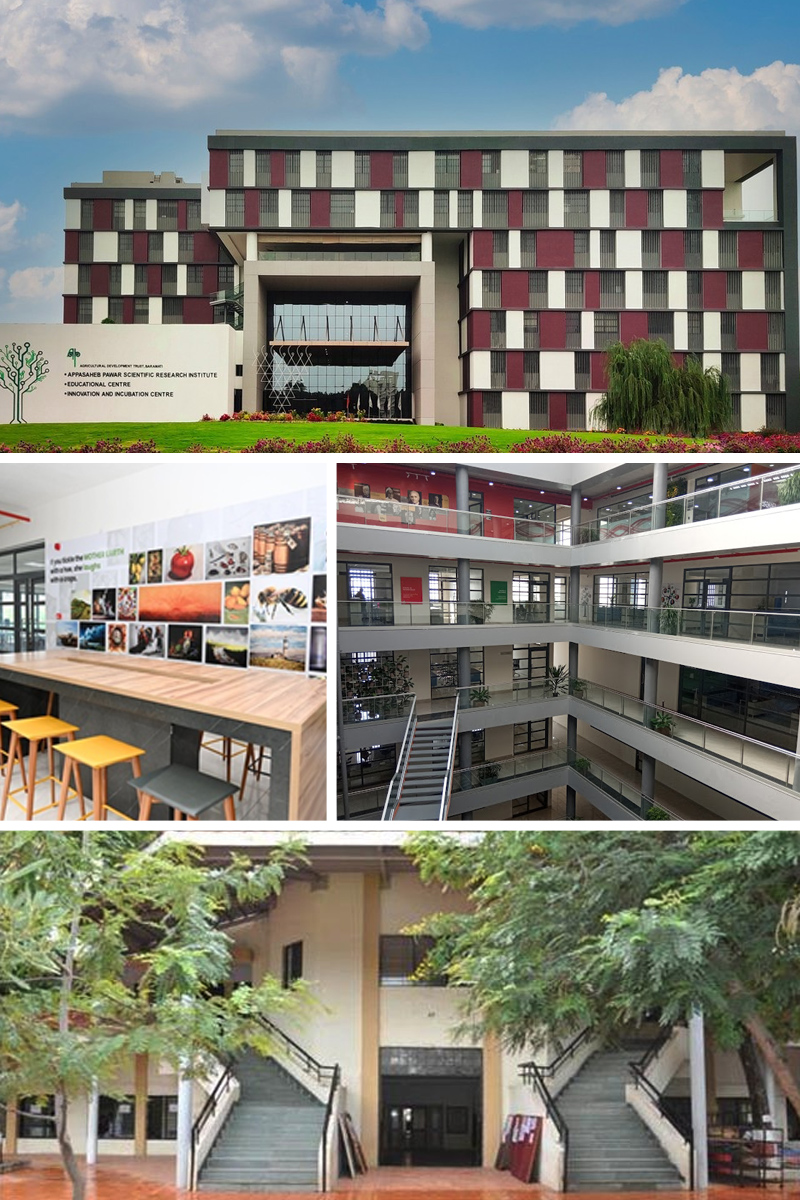
History of the Agricultural Development Trust, Baramati
The history of the Agricultural Development Trust (ADT), Baramati is deeply rooted in the
socio-economic transformation of a drought-prone region that once struggled for basic resources such as
food and water. In the late 19th century, Baramati faced severe famine, with people starving and migrating
for survival. To address this crisis, the British administration began constructing major irrigation
structures including the Nira Left Bank Canal, Khadakwasla Canal in Pune, and the Krishna Canal near Karad.
The construction of the Lloyd Bhatghar Dam on the Nira River in 1930 transformed irrigation capabilities and
brought relief to 22 villages in Baramati tehsil.
However, the remaining 43 villages continued to suffer due to their location in a rain-shadow zone. During
this difficult period, two Australian social workers from the Church Auxiliary for Social Action (CASA),
Miss Hessel Skues and Miss Edna Wazar, played a remarkable humanitarian role by distributing food and
essentials to famine-affected communities.
In 1965, a young graduate and “son of the soil,” Hon. Shri Sharadchandraji Pawar,
began working intensively among the people. Recognizing the urgent need for water conservation, he initiated
the construction of percolation tanks under the “Food for Work” programme with the support of Miss Skues and
Miss Wazar. The first percolation tank was constructed at Tandulwadi in 1967. Over the years, around
80 percolation tanks were built, significantly improving groundwater levels and agricultural
sustainability.
During the 1970s, Baramati remained drought-prone, with agriculture entirely dependent on the monsoon.
To tackle recurring droughts and to promote scientific agriculture, Hon. Shri Sharad Pawar
established the Agricultural Development Trust (ADT) in 1971.
Financial support was sought from international humanitarian agencies such as Lutheran World Relief (USA),
Christian Aid (London), and Teredes Homes (Germany). Central Bank of India provided loans to farmers for
digging wells, guaranteed by the Trust. Kirloskar Oil Engines donated irrigation engines at subsidised
rates, which accelerated the region's agricultural progress. Nearly 289 percolation tanks
were constructed, creating a revolutionary shift in the villages.
As responsibilities grew, Hon. Shri Appasaheb Pawar assumed leadership of the Trust in
1976. His visit to Israel in 1970 inspired the adoption of advanced irrigation and farming technologies.
Under his guidance, a barren 110-acre land near Malegaon (Kh) was transformed into a model demonstration
farm. Farmers across Maharashtra visited the Trust for training in horticulture, irrigation, organic
farming, fertigation, and modern agricultural practices.
The Trust diversified into dairy, poultry, goatry, nurseries, mechanized farming, and agri-processing,
creating new livelihood opportunities. The introduction of hybrid cows and quality fodder improved milk
production, raising the economic status of farming households.
A major turning point came with the vision to educate and empower rural girls. Dr. Appasaheb Pawar realized
that many families avoided sending girls far away for education. To address this, he established a
comprehensive educational complex for women at Shardanagar, starting with a Women's Education College in
1989. Over time, schools, junior colleges, Shardabai Pawar Arts, Commerce & Science College, D.Ed. College,
Nursing College, hostels, and training facilities were established. Today, nearly 6000 girls
pursue education on the campus.
After the passing of Dr. Appasaheb Pawar in 2000, the Trust leadership was taken forward by
Hon. Shri Rajendra Pawar and Hon. Sou. Sunanda Pawar. They expanded the
Trust's initiatives in areas such as women's empowerment, environment protection, entrepreneurship,
agri-innovation, cultural development (Srujan Festival), and the renowned Bhimthadi Jatra—an exhibition and
marketplace for women's Self Help Groups.
The Trust also introduced competitive examination centres, police recruitment training, entrepreneurship
development training for girls, and international collaborations with institutions like Van Hall Larenstein
(Netherlands), UC Davis (USA), AIT (Bangkok), and Yunnan Agricultural University (China).
Today, the Agricultural Development Trust stands as a symbol of rural transformation—supporting farmers,
empowering women, fostering education, advancing research, and uplifting socio-economic conditions across
Maharashtra. The vision of the Pawar brothers continues to guide the Trust as it builds a brighter, more
prosperous future for generations to come.